 Bluco Projects
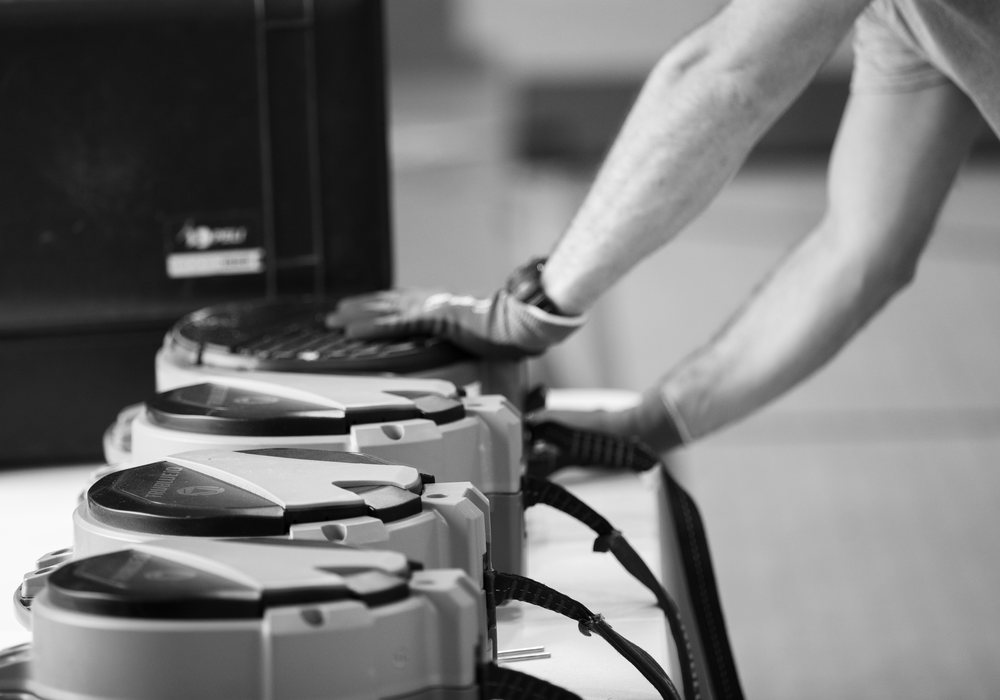
Auto-belay webbing: worn out before it looks it
The webbing is the part of an auto-belay that every climber touches and almost nobody looks at. It runs out and back on every climb, carries the climber's weight on every descent, and passes through the mouth of the device each way. On a busy wall that is thousands of cycles a year.
Webbing doesn't fail suddenly. It wears, a little each time, and then it fails. It stays flexible and it still holds, right up until it doesn't, and by the time it looks obviously wrong it has usually been wrong for a while.
None of what follows comes from BS EN 12572. The checks on an auto-belay are set by whoever made it, and the manual for the device on your wall is the one that counts. That matters more than it sounds, because the same badge can sit on units with different rules. TRUBLUE is the obvious example. The original TRUBLUE and TRUBLUE XL share one operator manual and the TRUBLUE iQ has another, and the two do not say the same thing.
Both put the day-to-day checking of the webbing on the operator, and both publish wear tables: webbing shown at successive stages of wear, with the point at which it has to be replaced. That is the test. Not whether it looks all right to whoever happens to glance at it, but where it sits against the maker's own stages. And at the full-length check the manual is blunter still: if there are any signs of wear or damage, replace the webbing.
Every six months both manuals ask for more. The unit comes down to a bench, the nozzle comes off, and the webbing is drawn right out and passed through the hands under a good light, including the first length that normally sits behind the nozzle where nobody sees it. The nozzle itself is checked for wear at the same time. That is still the wall's own inspection, done by someone trained to do it, and it has its own record.
Where they part is on age. The iQ manual says its webbing should be replaced after a year and a half of use whatever its condition, and that the date the webbing was made is to be recorded in the inspection log. That belongs to the iQ only. The manual for the original units sets no such interval, and for those the wear tables and the condition of the webbing decide.
There is a trap in the iQ worth knowing about. It takes iQ webbing and nothing else. The manual says not to fit original TRUBLUE webbing or another maker's, and is blunt about the consequences. On the wall you tell them apart by the yarn: iQ webbing has a white yarn running down the centre.
Then there is the label. The certification label on the side of the housing is what says the device may be in use at all. It carries the serial number, the date of manufacture, when it was last recertified, when the next is due and who did it. That next date is the one that governs, and it is read off the label. It is not worked out from the date of manufacture, whatever interval you may have been told. Recertification is annual and is done by an authorised service agent, and a service record on file is useful to have alongside.
What the label does not show is the daily, weekly and six-monthly checks. Those belong to the wall. The daily and weekly ones nobody else can do for you; the six-monthly one can be done for you, and it is work we carry out.
At a main inspection we draw the full length of the webbing out and examine it, read the certification label, and ask to see the daily, weekly and six-monthly checks recorded since our last visit. Parts of a main inspection cannot be done with the unit on the wall, so expect it to come down.
Four things are worth doing this week, and none of them needs us. Find out exactly which model you have and get its manual. Read the dates on the label. Put the webbing on a weekly check against the maker's wear tables, with a name against it, written down each time, including the weeks when nothing was found. Those are the entries that show the check is real. Then put the six-month inspection in the diary.
Auto-belays are one part of the PPE a duty holder is responsible for. Our free seven-page guide sets out what BS EN 12572 actually asks of the person responsible for a climbing wall — and what it does not: get the guide.