 Bluco Projects
Not every anchor on a climbing wall is a climbing anchor
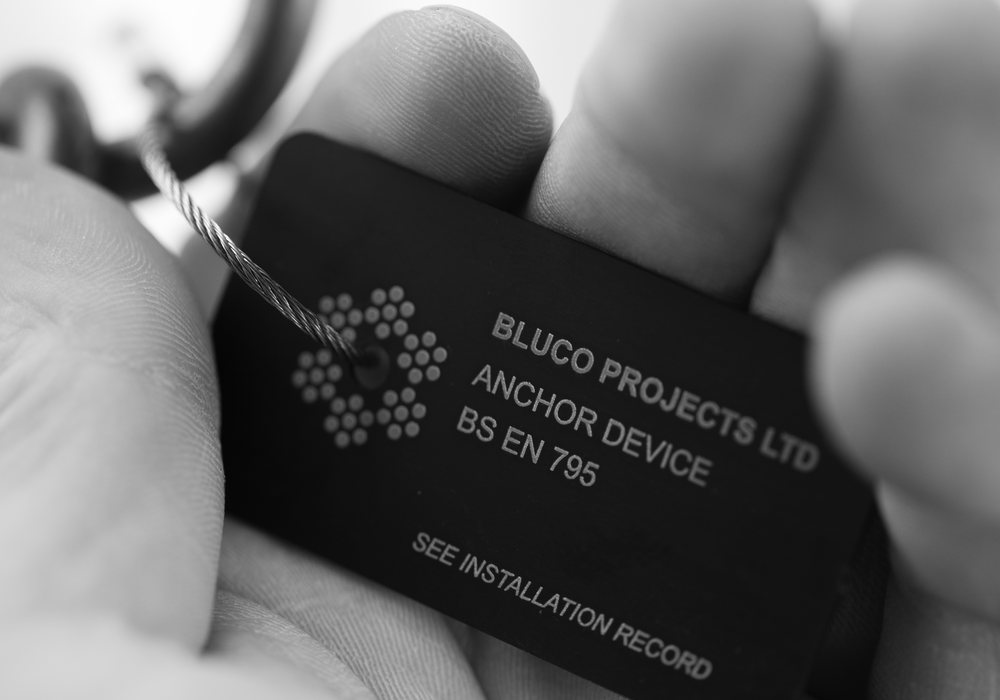
Pictured: an anchor device installed and tagged by Bluco Projects, with its installation record on file.
Look up at the top of a climbing wall and you will see steel bolted to it. Most people call all of it anchors. On many walls it is two different things, and the difference decides how each one is inspected and what anybody is entitled to hang from it.
The first is the protection point. It is where a climber's rope runs: the bolts and hangers up a lead route, the lower-off at the top of a line. BS EN 12572-1 treats these as part of the wall. They are designed with it, tested with it and inspected with it, and that is the standard that applies to them.
A protection point is not an anchor device and does not claim to be. As a rule it carries no EN 795 marking, no installation record of its own and no maker's declaration saying it is one. That is not a shortcoming. It was made to hold a falling climber on a climbing rope, as part of a wall designed around it, and that is what it is judged against.
The second is the anchor device. Plenty of walls have them: a point fitted so that somebody can work at height on the structure, to set routes, change a lamp or get behind a panel. This is different kit with different paperwork. It is made to EN 795, and BS 7883 sets out how an anchor system of that kind should be designed, installed, recorded and inspected. That standard is written for people at work, not people climbing for sport, and it expects a file to exist for each system saying who designed it, who fitted it and what it is for.
So the climbing wall standard covers the wall. The others come into it only when something on the wall was fitted as an anchor device: made to EN 795, marked as one, with an installation record and a stated purpose.
From the floor the two can look much alike, and that is where the trouble starts. The mistake worth avoiding is treating the first as the second. Clipping a climbing bolt to work from does not turn it into an anchor device. It means somebody is working from a point that nobody has established a rating for, for that use.
The opposite mistake is quieter. An anchor device with no label, no file and nobody left who remembers fitting it is still on the wall, and it still looks like something to clip to.
So at an inspection we record the declared use of every anchor device we find: what it is for, and on whose account. "Not established" is an answer, not a blank. If nobody can say what an anchor is for, that is a finding, because the declared use is what decides how it should be inspected.
What duties follow from that is for the duty holder to establish with their own advice, and our reports say so. Our part is to say what is there, what it was made for as far as anyone can show, and what could not be established.
Three things are worth doing this week, and none of them needs us. Walk the wall and list everything on it that is not a protection point. For each one, find its label and its paperwork. Then ask whoever works at height on your wall what they attach to, and whether it is on that list.
Knowing what is on your wall is one part of a duty holder's wider responsibility for it. Our free seven-page guide sets out what BS EN 12572 actually asks of the person responsible for a climbing wall — and what it does not: get the guide.